
Long-term reuse strategies, economic and financial sustainability, and participatory processes to generate value through urban regeneration projects: the case study of Hangar Creativi in Livorno.
Livorno has gained a new public space to foster culture and creativity: Hangar Creativi, located in the former depot of the Azienda Autonoma dei Trasporti Livornese (ATL).
In 2023, Sinloc developed the socio-economic sustainability study “Hangar Creativi – Regenerated Spaces for Art, Culture and Enterprise” on behalf of the Municipality of Livorno. The study is a key component of the city’s strategy for the regeneration of five strategic urban transformation areas identified in the Municipal Operational Plan: Rivellino, Scopaia District, Ippodromo, Parco delle Generazioni, and the former ATL site.
The study aimed primarily at defining criteria to guide planning decisions and determining the conditions required to activate Public-Private Partnerships.
From Abandonment to Temporary Use
The history of the former ATL depot dates back to the late 19th and early 20th centuries, when the tram company relocated its depots to the current Via Meyer. As public transport evolved, the depot was relocated again in 2015, leaving the 17,000 sqm site unused and mostly abandoned until late 2021.
The site’s revival began in 2021, when the Municipality participated in the Italian Pavilion of the 17th International Architecture Exhibition – Venice Biennale, focused on resilient communities. Two warehouses were refurbished to host conferences, seminars, and artistic performances linked to the Biennale. Since then, the site has become Hangar Creativi, a new public space that continues to host events and cultural initiatives.
Strategically located near key cultural and leisure attractions—such as the seafront, the Aquarium, the Terrazza Mascagni, and the Fattori Museum in Villa Mimbelli—the area is well-positioned for urban and cultural development.
Long-term reuse strategy
Reopening this space has initiated a broader regeneration process, reconnecting the area with nearby cultural hubs and the sea, while highlighting the potential of culture and creativity as drivers of local economic growth.
With this vision, in 2022 the Municipality proposed the creation of an “Advanced Cultural District” at Hangar Creativi, in partnership with the Goldoni Foundation, the city’s main theatrical institution. The project was selected by the Tuscany Region and awarded approximately €8 million in EU cohesion policy funds.
Culture as a productive asset
“Culture not only as a driver for reclaiming abandoned spaces, but also as a process of investment and production.”
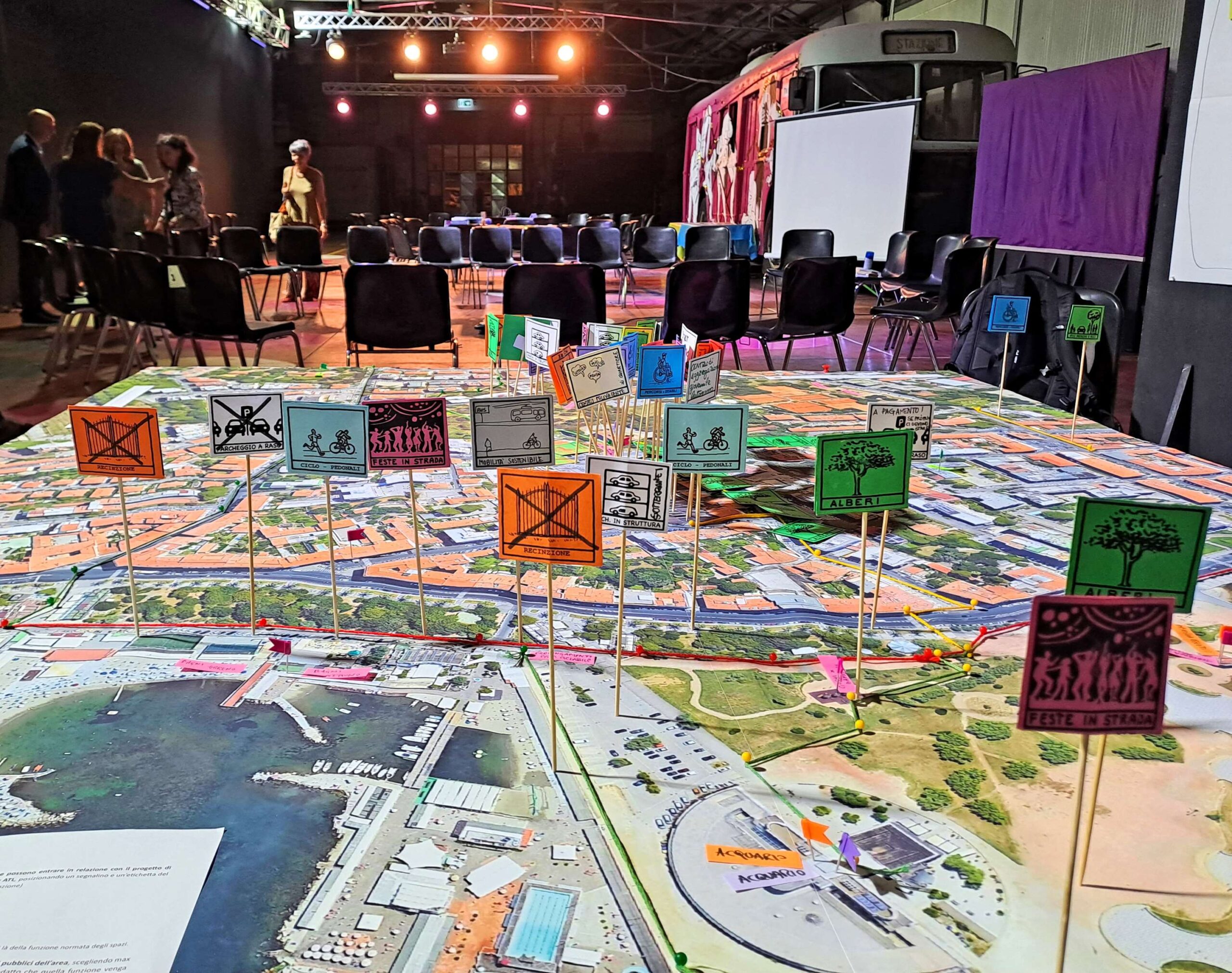
Based on this concept, we designed a participatory process and market testing initiative involving cultural operators, private investors, and institutions. The goal was to assess development hypotheses, potential benefits, user base, and emerging opportunities.
This analysis revealed development potential in the creative industries sector and specific needs for infrastructure and services, such as accommodation and parking.
Hangar Creativi will bring together in one location multipurpose spaces for exhibitions, fairs, and events; a theatre; workshops for set design and audiovisual production; and ancillary services (such as a café, parking, and guest accommodations, etc.). This will stimulate youth entrepreneurship and support emerging professions.
Public-Private Partnership and Project Development
The economic-financial feasibility study assessed the sustainability of the site’s redevelopment through a Public-Private Partnership (PPP) model.
The project entails substantial investment in publicly managed facilities (cultural functions and open space regeneration), for which sustainability scenarios were analyzed.
The total estimated investment is €40 million.
The process led to the definition of the Preliminary Project Document (DIP), which served as the foundation for the Technical-Economic Feasibility Project entrusted by the Municipality to a consortium led by Corvino + Multari SRL.
Through stakeholder engagement, sector opportunity mapping, design guidelines, and PPP feasibility assessments, this project is coming to life—combining economic sustainability, social impact, and the valorization of the connections between culture and innovation.